
Posted On: August 20, 2026
Whether you have been going to checkups for years or have not seen a doctor in a while, most adults do not carry a complete vaccine record in their head. You may remember a tetanus shot before a trip, a flu vaccine last fall, or the shingles vaccine a friend recently mentioned, but the rest can be surprisingly hard to piece together.
To add to the confusion, recommendations do not stop after childhood but continue to change with age, health conditions, medications, pregnancy, travel, and work, and sometimes with new evidence or updated guidance from the medical organizations we trust.
Federal vaccine recommendations have shifted over the past year with neither new evidence nor regard for longstanding and well-researched data supporting the previous recommendations. The confusion created by the abrupt changes is likely to lead to fewer vaccinated and protected individuals across the country, which is not good for the health of the nation.
Our practice follows the guidance of the American College of Physicians, which reviews the evidence behind adult immunization and supports both the American Academy of Family Physicians adult schedule and the American College of Obstetricians and Gynecologists maternal schedule. As a Fellow of the American College of Physicians and a representative on the Council of the ACP Virginia Chapter, I have committed to ACP guidance as my standard, and that is the foundation for everything in this article.1
Vaccination is one of the most effective tools we have in medicine, credited with saving millions of lives worldwide, and staying current on your own schedule is part of how that protection holds up at the individual level. This article walks through what the evidence shows, gives you a chart you can bookmark, and points out which parts of your own schedule deserve a closer conversation.
The two questions I hear most often are: how do we know vaccines work, and are they safe?
A vaccine works by teaching the immune system to recognize a specific germ, so the body already knows how to respond if it is ever exposed to the real thing, without having to get sick first to build that defense. Some immunity lasts for decades. Some fades over time, and some viruses, like influenza, change enough each year that last year’s protection will not fully cover this year’s strain. That is why you may need a shingles vaccine series once, a tetanus booster every ten years, and a flu vaccine yearly.
The key for vaccination is herd immunity, which is what happens when enough people in a community are protected, whether through vaccination or prior infection, that a disease has a harder time finding a new person to infect. That slows the spread and gives extra protection to people who cannot be vaccinated themselves, such as newborns or people with certain medical conditions.
It is important to know that while vaccines do carry risks, the reality is that vaccines have saved 150 million lives over the past 50 years.2 The most common reactions are mild and pass within a day or two, such as soreness at the injection site, a low fever, or feeling run down, and serious reactions are tracked closely and are genuinely rare.
Clinicians and public health agencies keep monitoring vaccines for years after they reach the market, watching for patterns that would not show up in a clinical trial. A single report raises a question rather than proving a cause, and researchers spend significant time comparing records, timing, and background rates before they draw any conclusion.3
I use age as a starting point, then I look at prior doses, health conditions, medications, work, travel, and pregnancy plans. The AAFP schedule provides the framework, and the chart below turns it into simple actions.4
“Get” means routine for most people in that age band.
“Check” means to confirm records or immunity.
“Discuss” means your risk and history decide.
“Not routine” means you usually do not need it without another reason.
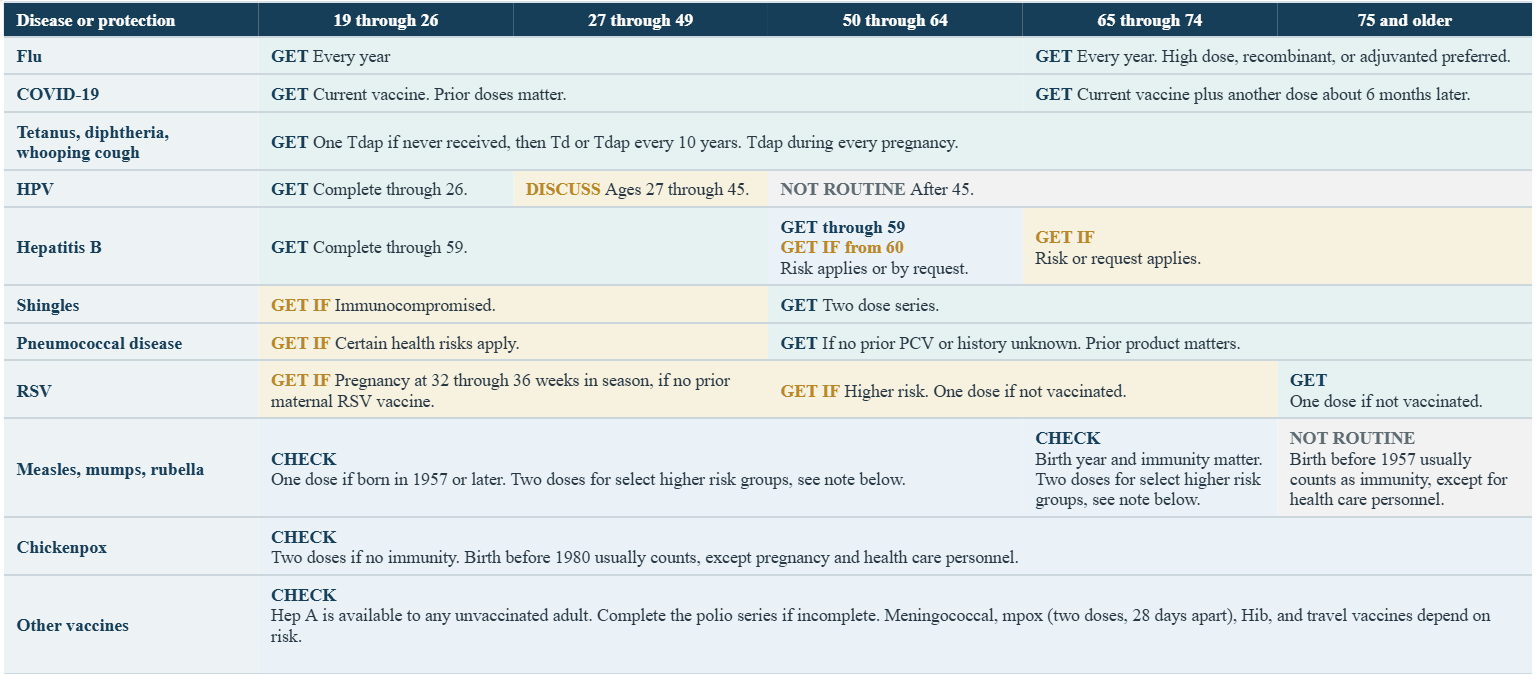
Last reviewed August 20, 2026. Based on the 2026 AAFP adult immunization schedule, published and supported by the American College of Physicians. This chart does not replace a personal review. Prior doses, immune treatment, and pregnancy can change the next step.
One line in the chart is worth a closer look. MMR is one dose for most adults born in 1957 or later, but two doses are recommended for health care personnel, students in postsecondary institutions, international travelers, and household contacts of someone who is immunocompromised. If you fall into one of those groups, my measles guide covers the adult MMR question in more detail.
Fifty is a bigger turning point than most people expect. Shingles vaccination becomes routine as a two-dose series, and pneumococcal vaccination now starts here rather than waiting until 65. That second change catches a lot of patients off guard, since 65 was the number most of us grew up hearing. Put together, the items adults over 50 most often assume they have already handled are pneumococcal vaccination, the shingles series, a Tdap booster every ten years, and hepatitis B catch-up for anyone who never completed the series.
The list can also include one RSV dose from age 50 through 74 when heart or lung disease, immune problems, frailty, or other factors raise your risk of severe illness.5
By 65, the focus shifts toward protection against infections that can cause more serious complications later in life.
For influenza (flu), adults 65 and older should preferentially receive a high-dose, recombinant, or adjuvanted vaccine when one is available. If a preferred option is not available, an age-appropriate influenza vaccine still offers protection.6
At age 75, RSV vaccination becomes routine for adults who have not already received a dose. This is also a useful time to confirm shingles, pneumococcal, tetanus, influenza, and COVID-19 status rather than assuming everything was completed earlier.
These reviews become especially valuable when care has taken place across several physician offices or pharmacies over many years.
Flu comes back every year because the virus keeps changing and the protection from last year’s vaccine fades within months. The AAFP schedule recommends vaccination in September or October, though a dose later in the season still helps while flu activity continues. People with chronic heart or lung disease, a weakened immune system, or pregnancy face a higher risk of complications, and so do adults 65 and older, who should look for the high dose, recombinant, or adjuvanted option rather than the standard shot given to younger adults.
COVID-19 recommendations changed this year, and I think that shift is part of what makes this vaccine feel confusing right now. Where COVID-19 vaccination was once framed as a blanket seasonal recommendation, the CDC has moved toward individual decision-making instead. Our practice continues to follow ACP, which supports the schedules published by AAFP and ACOG rather than that newer federal framing. In practice, that means I still treat COVID-19 as a personal conversation rather than a universal recommendation. I weigh your age, prior infection and vaccination history, immune status, pregnancy, chronic disease, travel plans, and current exposure. Older adults and people carrying more medical risk usually have the most to gain.
RSV does not currently need an annual dose. Flu, COVID-19, and RSV vaccines can typically be scheduled around the same time when each one fits your situation. The flu shot can be given right here in the office, while COVID-19 and RSV vaccines are handled through a prescription sent to your local pharmacy, and you can still space them out or use different arms if that is more comfortable for you.
RSV is a leading cause of severe respiratory illness at both ends of life, in adults 75 and older, in adults 50 through 74 who carry increased risk, and infants. Infants are protected one of two ways: through a maternal RSV vaccine given during pregnancy, which passes protection to the baby before birth, or through a separate antibody dose given directly to the infant after birth when the maternal vaccine was not given or does not apply. If you are pregnant or expecting a baby soon, this is worth raising at your prenatal visit, since it decides which path fits your situation.
Most of the adult schedule applies the same way regardless of sex, but a few areas shift specifically for women: pregnancy and preconception planning, HPV vaccination, and the autoimmune conditions that show up more often in women and can change vaccine timing.
Vaccines during pregnancy protect two people at once, and timing matters more here than almost anywhere else in the schedule. ACOG recommends Tdap in every pregnancy, ideally between weeks 27 and 36, and a flu vaccine in any trimester. A maternal RSV dose may fit between weeks 32 and 36 during RSV season if you have not already received one.7 COVID-19 stays a personal risk conversation between us rather than a standard recommendation.
Before conception, I check your MMR and varicella immunity. Both are live vaccines, so they are given before pregnancy begins or after delivery if you lack immunity. HPV vaccination is paused during pregnancy and picked back up afterward, at whatever dose you left off.
HPV vaccination is routine through age 26. Between 27 and 45, ACOG supports a shared decision based on your prior exposure and individual risk, and it is not typically recommended after 45. The biggest reason this vaccine matters is cervical cancer prevention. Most cervical cancer traces back to HPV infection, and the vaccine is one of the few tools in medicine that can prevent a cancer outright rather than simply catching it earlier.8
It is easy to think of HPV vaccination as something for girls and young women, but it protects men too, lowering the risk of several HPV-related cancers and reducing how easily the virus spreads to partners. If you have a son, a partner, or anyone in mind who has written this vaccine off as not relevant to them, it is worth revisiting.
Autoimmune conditions are more common in women, which is part of why they belong in this section.9
Autoimmune disease itself does not rule out vaccination. What matters more than the diagnosis is usually the medicine you are on. If a treatment lowers your immune response, I review live vaccines early and plan the timing around your treatment schedule rather than defaulting to the standard calendar.
Start with old physician offices, pharmacies, schools, colleges, employers, military records, and family files. Virginia residents can also use the Virginia Department of Health immunization record portal to view and print available records.10
Most series do not require a restart after a long gap. I can often resume a series partway through, use a blood test to confirm existing immunity in select cases, or give a single repeat dose when that is the simplest safe path forward.
At your comprehensive annual health assessment, I reconcile your records, look for gaps, review any past reactions, and match the current schedule to your actual health, not just your age. Our 60- to 90-minute visit gives us room to sit with any uncertainty rather than rushing past it.11
I want you to understand why I am recommending a vaccine, and just as importantly, why we might wait. The annual flu vaccine is included in your membership. Other vaccines are available for an added charge, and my team can help coordinate another site if that works better for you.
No. Your age, prior doses, immunity, health conditions, work, travel, and pregnancy all shape the final plan.
Yes. Most adults can receive multiple vaccines at the same time, including flu, COVID-19, and RSV when appropriate. If you are a member of the practice, the flu shot is available in the office, while COVID-19 and RSV vaccines are provided through a prescription sent to a local pharmacy.
No. I rarely restart a series just because years have passed. Bring whatever record you have, even a partial list.
Sometimes. Protection from a few childhood vaccines fades over time, which is why Tdap needs a booster every ten years and why MMR or varicella status is worth confirming if your childhood record is incomplete.
Tell me what happened, how soon it started, and whether you needed treatment. Arm pain and a mild fever call for a different plan than a severe allergic reaction does.
Advice changes as evidence, products, and disease patterns change, and so does your own health. You do not need to chase every headline to stay current. Save the chart, and bring your questions to your annual exam. Immunization is one of the oldest tools we have in preventive medicine and still one of the best supported by evidence.

Leading the way in women's healthcare is renowned board-certified internal medicine doctor Dr. Eileen West. She has over 20 years of experience and is recognized for her expertise in menopause, osteoporosis, and cardiovascular disease prevention. Her excellence-driven compassionate approach, which is associated with the American College of Physicians, improves the lives of her patients by putting a strong emphasis on their overall well-being.
Location: Fairfax, Virginia
Areas of Expertise: Women's Health, Menopause Management, Cardiovascular Disease Prevention, Osteoporosis Diagnosis and Treatment.
Join our Email Newsletter to get the latest and greatest tips on ways to maximize your health, invitations to educational events, and other practice news!
By submitting this form, you are consenting to receive marketing emails from Eileen West, MD and Associates.