
Posted On: December 11, 2025
Living in Northern Virginia or the DC metro area, you’re not imagining it — stress feels especially intense here lately. Many people are getting hit from several directions at once. Illness keeps circulating through schools, offices, and households. Political headlines feel nonstop and emotionally draining. The economy is uncertain, and layoffs in tech, federal contracting, and other industries have left a lot of families worried about the future. Add in the rising cost of groceries, childcare, housing, and gas, plus long commutes and packed schedules, it makes sense you feel worn down.
Your body has a built-in alarm system meant to protect you. When your brain senses threat or uncertainty, it activates your stress response, releasing cortisol and adrenaline so you can stay alert and handle what’s in front of you.
That’s helpful in short bursts. But when stress lasts for weeks or months, your system can get “stuck” in that high-alert place. And that can show up in very real ways, like:
If any of that sounds familiar, please hear this clearly:
“You are not weak, broken, or failing.”
Your body is responding exactly the way a human body responds when it’s been carrying too much for too long. Understanding that can soften the self-blame and make room for kindness toward yourself.
When everything feels overwhelming, grounding helps your nervous system settle back into the present moment. These don’t need to be big or time-consuming. Think of them as tiny signals to your body that say, “We’re safe right now.”
A few simple options:
For more details and ideas, this post goes deeper:
https://www.eileenwestmd.com/blog/5-smart-ways-to-manage-stress-and-restore-peace/
Stress gets louder when your mind is holding too many open tabs. A quick way to ease that burden is to take thoughts out of your head and put them somewhere visible.
Try:
This isn’t about being more productive — it’s about giving your mind a little breathing room.
Small stressors stack up quickly. A few gentle boundaries can lower the background noise:
Even tiny boundaries help your brain feel less “on call” all the time.
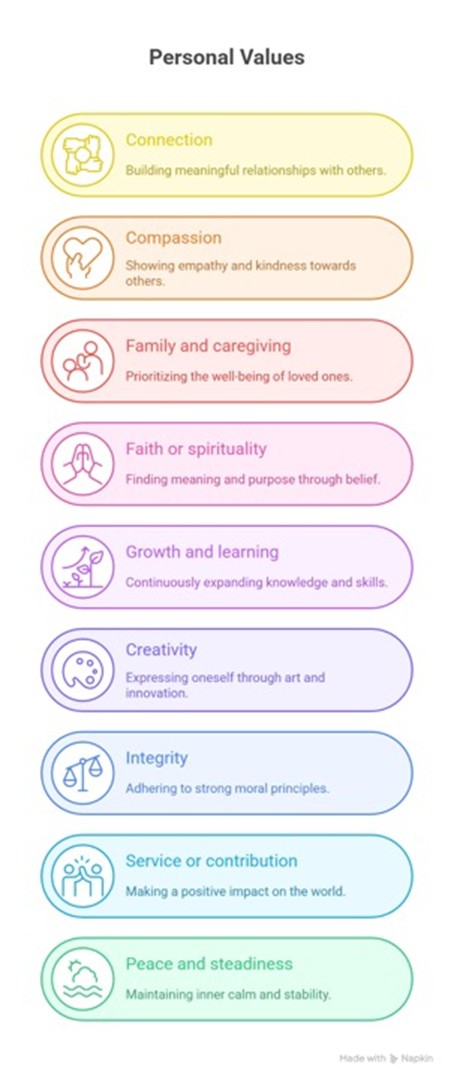
When stress is high, life starts to feel like pure survival. You do what’s urgent, what’s loud, what’s next. In that mode, it’s easy to lose track of what really matters to you — not because you don’t care, but because your system is overloaded.That’s where values come in. Values are your true north. They’re the qualities that matter most to you as a person. They don’t change based on circumstances. They don’t depend on whether life is calm or chaotic. They’re the inner compass you can return to when everything feels off course.
Research shows that when people live in ways that align with their values, they tend to feel more grounded, resilient, and hopeful, even when life is hard. Values give you a sense of direction when the path ahead feels unclear.
A helpful reflection is:
You don’t need a big list. Just naming two or three can be enough to help you feel oriented again.
Once you reconnect with your True North, the next step is simple:
Choose one small action each day that matches your values.
Not a huge change. Not a full life reset. Just one doable step that says, “I’m still me, even in this mess.”
Examples:
These tiny actions have real emotional impact. They remind your brain that you still have choice and agency. And that sense of agency is one of the strongest antidotes to helplessness and overwhelm.
A simple routine:
Each morning, ask:
“What’s one small thing I can do today that reflects what matters to me?”
Then keep it small enough that you genuinely can do it.
Stress makes life feel smaller. It isolates us without meaning to. Our nervous system gets wrapped up in protection mode, and we can start feeling alone, disconnected, or like we’re carrying everything ourselves.
This is why tiny acts of kindness are so meaningful. They don’t fix the world, but they remind your brain and body that warmth still exists.
Micro-connections might look like:
Moments like these release oxytocin (the “connection hormone”), which helps calm the stress response and lifts mood, while also creating a sense of meaning.
Even when everything feels heavy, human connection helps us keep going.
When stress is high, your brain naturally pays more attention to what’s wrong. That’s not because you’re negative — it’s because your brain is trying to protect you. It’s scanning for problems so you can prevent harm.
But over time, that constant scanning can leave you feeling like nothing good exists anymore.
That’s why it helps to gently retrain your attention. A simple practice:
Three Good Things
At the end of the day, write down three things that were good, or even just okay.
They can be tiny:
This isn’t pretending everything is fine. It’s reminding your brain that good and hard can exist at the same time. With repetition, this practice strengthens resilience and helps your nervous system feel less trapped in survival mode.
Sometimes what you’re carrying is simply too much to hold alone. If stress is starting to affect your daily life, relationships, or health, reaching out for support is a wise and caring choice.
Signs that extra support may help:
Support may be counseling, medical care, a trusted friend, or a care team. Getting help isn’t a last resort. It’s a proactive step toward feeling better.
Joy is not the absence of stress. Joy is the quiet, steady practice of returning to what grounds you and helps you feel like yourself again.
In heavy seasons, you don’t need to do everything. You need small, meaningful steps:
You are allowed to be human in a hard time. And even then, meaning is still available to you, sometimes in the smallest moments. That’s where joy starts to grow again.

Leading the way in women's healthcare is renowned board-certified internal medicine doctor Dr. Eileen West. She has over 20 years of experience and is recognized for her expertise in menopause, osteoporosis, and cardiovascular disease prevention. Her excellence-driven compassionate approach, which is associated with the American College of Physicians, improves the lives of her patients by putting a strong emphasis on their overall well-being.
Location: Fairfax, Virginia
Areas of Expertise: Women's Health, Menopause Management, Cardiovascular Disease Prevention, Osteoporosis Diagnosis and Treatment.


Sleep is not a luxury. It’s foundational medicine. Poor sleep impacts blood sugar, weight, mood, hormones, immunity, and heart health. If you’re struggling with insomnia, waking frequently, or feeling exhausted despite “enough” hours — that’s a signal worth exploring. Sometimes it’s stress. Sometimes hormones. Sometimes sleep apnea. Sometimes habits. Let’s get curious about your sleep — and create a plan that restores real rest. #sleephealth #worldsleepday #conciergecare #restorativesleep #preventivemedicine #EileenWestMD

Patient safety isn’t a checklist — it’s a culture. Clear communication. Thoughtful prescribing. Coordinated care. Time to ask questions. These are not luxuries — they are essentials. In a concierge model, fewer patients means more attention to detail, better follow-through, and proactive prevention. Because safety starts with being known — not rushed. If you ever have questions about your medications, test results, or treatment plan, we want to hear them. #patientsafety #safecare #conciergemedicine #proactivehealth #healthcarequality #EileenWestMD

Congratulations to Dr. West for being recognized as a Top Doctor by Northern Virginia Magazine, Castle Connolly, and Washingtonian Magazine Hall of Fame. We’re proud to see her dedication to exceptional patient care recognized nationally and across the region. #EileenWestMD #TopDoctor
Join our Email Newsletter to get the latest and greatest tips on ways to maximize your health, invitations to educational events, and other practice news!
By submitting this form, you are consenting to receive marketing emails from Eileen West, MD and Associates.